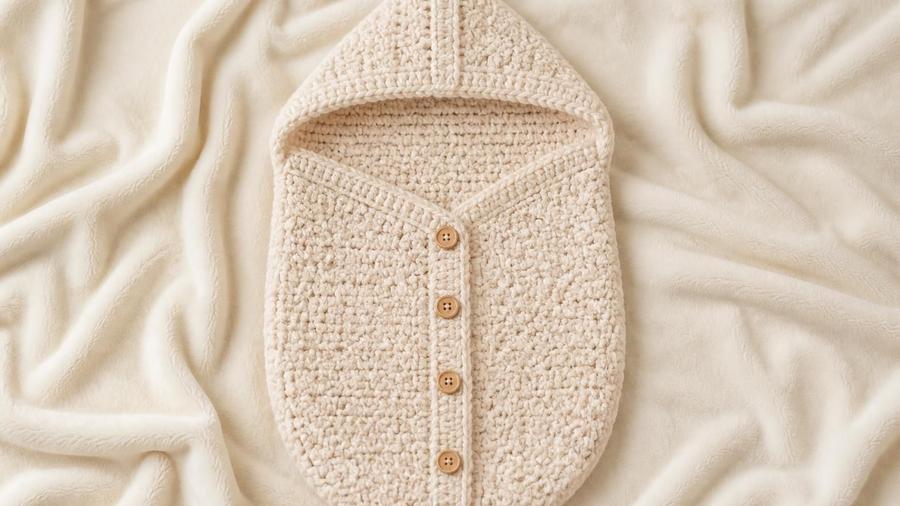
A soft, hooded sack with a button-front closure, worked in a plush chunky yarn — the pattern I reach for every time someone I know is expecting.
Updated 2026 · US terms · Sizes 0-3mo, 3-6mo
I made my first cocoon for a friend's newborn photo session, and I remember being a little precious about it, worried it needed to be some kind of everyday essential to justify the hours I put in. It doesn't. A cocoon like this earns its keep in short, supervised bursts: photos, a cuddle on the sofa, being held while you're both awake. That reframing actually made the project more fun to make, not less, because I stopped trying to engineer it into something it isn't.
The construction itself is simpler than it looks. The body is a tapered oval tube worked in the round from a pointed base, which then opens into flat rows for the front opening. The hood is just a folded, seamed rectangle, no complicated shaping at all. A button band down the front finishes it off, with no ties or cords anywhere near the neck.
Below is the full pattern in US terms, along with sizing notes, yarn recommendations, and — because this is genuinely important for an item like this — clear guidance on how a handmade cocoon fits into safe sleep practice. If you're newer to garment shaping, our easy baby blanket pattern is a gentler place to start first.
I also think this is one of the more forgiving garment projects to attempt if you've never shaped anything beyond a blanket or a hat before. There's no sleeve to set in, no fitted waist, and the two techniques that do all the real work, the oval base and the fold-and-seam hood, are both genuinely simple once you've done them once. If you can make an amigurumi ball and a basic rectangle, you already have every skill this pattern asks for.
A note on safe sleep: a handmade cocoon like this one is best used for supervised time only — photos, awake cuddle time, being held — rather than placed in a crib or bassinet for unsupervised sleep. Current safe-sleep guidance recommends a bare sleep space with no loose blankets, bunting, or soft bedding. If you're planning to use this for photos or a nursery keepsake rather than everyday sleep, that's exactly the use it's designed for; if you have questions about safe sleep for your own baby, check current guidance from your pediatrician.
Materials
About 350–450 yards of super bulky or chunky weight yarn
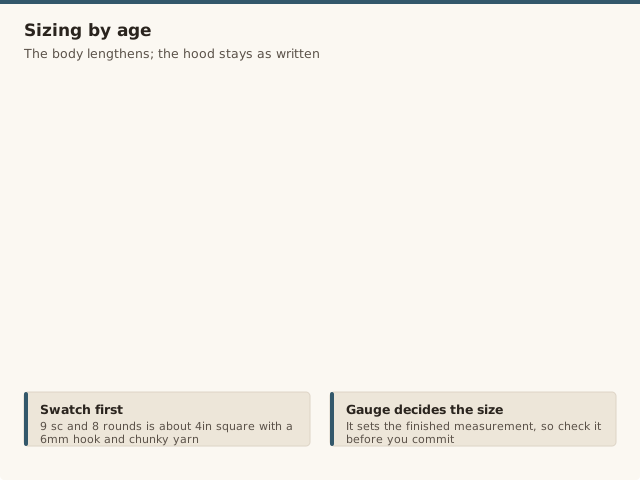
9 sc and 8 rounds measures about 4in / 10cm square with a 6mm hook and chunky yarn. Gauge matters here since it determines the finished size; swatch first if you can.
Notes
Sizes given are 0–3 months (as written) and 3–6 months (sizing note below).
The body is worked in the round from a flat oval base, then converted to flat rows for the front opening.
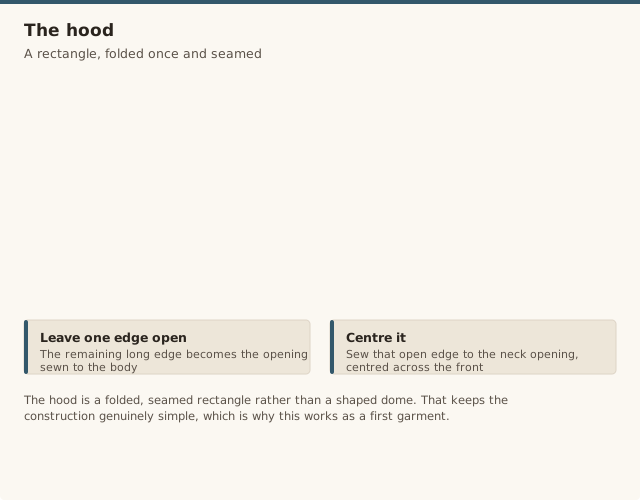
The hood is a folded, seamed rectangle rather than a shaped dome, which keeps the construction simple.
Pattern
Base
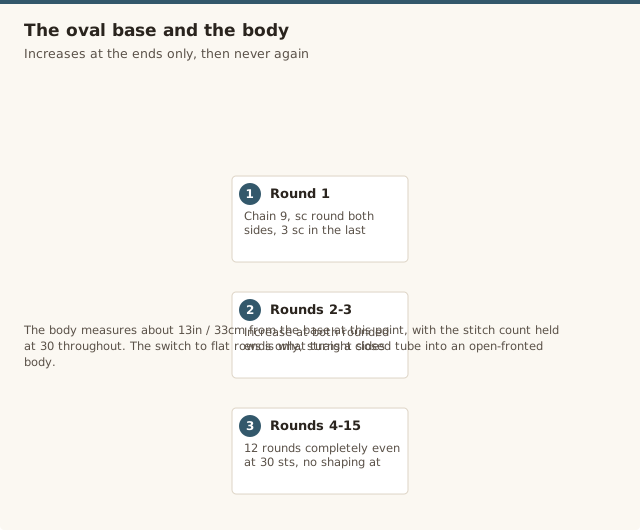
Chain 9. Single crochet in the 2nd chain from the hook and in the next 6 chains, 3 single crochet in the last chain, then working along the opposite side of the foundation chain, single crochet in the next 6 chains, 2 single crochet in the last stitch to close the oval. (18 sc)
Rounds 2–3 (increase)
Round 2: working in a continuous spiral, increase evenly at both rounded ends of the oval, single crochet along the two straight sides without increasing. (24 sc)
Round 3: repeat the same increase pattern at both ends. (30 sc)
Rounds 4–15 (straight body)
Single crochet in each stitch around for 12 rounds, no shaping. (30 sts each round) The body should now measure about 13in / 33cm from the base.
Converting to rows (front opening)
At the start of the next round, chain 1 and turn. From here, work back and forth in rows rather than continuing in the round, keeping the stitch count at 30 throughout. Work 8 rows even. This turns what was a closed tube into an open-fronted body, ready for the neck and button band.
Hood
Separately, chain 22. Row 1: single crochet in the 2nd chain from the hook and each chain across, turn. (21 sts)
Rows 2–18: chain 1, turn, single crochet in each stitch across. Fasten off, leaving a long tail.
Fold the rectangle in half so the two short edges meet, and seam along the top and back edge (the fold and one long side) to form the hood's dome shape, leaving the remaining long edge open. Sew this open edge to the neck opening of the body, centering it evenly across the front opening.
Button band
Along one front edge, work a strip of single crochet from the base to the neck, placing 4 evenly spaced 2-chain buttonholes as you go (skip 2 stitches, chain 2 over the gap, continue). Along the opposite front edge, work a matching plain strip with no buttonholes. Sew 4 buttons onto the plain strip to align with the buttonholes.
Sizing by age
As written, this pattern fits 0–3 months, finishing at about 19in / 48cm from the base of the oval to the top of the hood. For 3–6 months, work 4 extra straight rounds at step 3 (16 rounds total instead of 12) before converting to rows, which adds about 2.5in / 6cm of extra length, and add 2 extra rows before starting the hood so the neck sits comfortably lower. The hood itself doesn't need resizing for either age range, since a bit of extra room around the head is comfortable rather than a problem.
Choosing yarn and hook size
A super bulky or chunky weight yarn is what gives this cocoon its plush, fast-growing texture, and it also means the whole project finishes in a reasonable number of hours despite its size. Stick to a soft, machine-washable fiber, acrylic, an acrylic-cotton blend, or a superwash wool are all good choices, and avoid anything with a rough or scratchy hand feel, since this sits directly against a baby's skin and face. Our yarn weight guide covers how substituting a different weight would affect both gauge and yardage if you want to adjust this pattern.
Care & washing
Check the yarn label before washing, but most machine-washable chunky yarns tolerate a gentle cycle inside a mesh laundry bag, which also protects the buttons from catching on anything else in the wash. Lay flat to dry rather than using a tumble dryer, since heat can felt or shrink some fibers, and a bulky, saturated piece like this takes a while to dry evenly either way, so plan for it to sit out for a day.
Common mistakes & fixes
Mistake: the oval base comes out lopsided instead of symmetrical.
Fix: place a stitch marker at the start of each round and count your stitches at both rounded ends separately before moving on; an uneven increase at one end versus the other is the most common cause.
Mistake: the front opening doesn't lie flat once you've converted from rounds to rows.
Fix: double-check your stitch count stayed at 30 through each row of the conversion; a stitch accidentally gained or lost during the switch is the usual culprit and shows up as a slight flare or pucker at the front edge.
Mistake: the hood ends up too small or sits awkwardly on the head.
Fix: check your gauge swatch before starting the hood rectangle, since the hood's finished size depends entirely on your own tension matching the pattern's gauge rather than any shaping.
Mistake: the buttonholes and buttons don't line up once both front bands are finished.
Fix: work both bands to the same total row count, and mark the position of each buttonhole with a scrap of yarn before sewing on buttons, checking alignment before committing to permanent stitches.
Mistake: a button comes loose after repeated use.
Fix: sew each button on with several passes of doubled thread or yarn through a sturdy anchor point, and check all buttons periodically for looseness, standard care for any baby garment with small hard attachments.
Our pick
Yarn
Bernat Blanket Yarn
A soft, machine-washable super bulky yarn that grows a project quickly and holds up well to regular washing, a good match for this pattern.
Is a crochet baby cocoon safe for a baby to sleep in unsupervised?
No. Current safe-sleep guidance recommends a bare sleep space with no loose blankets, bunting, or soft bedding, and a handmade cocoon like this one is best used for supervised time only, such as photos, awake cuddle time, or being held, rather than placed in a crib or bassinet for unsupervised sleep. If you're unsure about safe sleep practices for your baby, check current guidance from your pediatrician or a body like the AAP.
What age is this cocoon sized for?
The pattern as written fits 0 to 3 months. Sizing notes are included for scaling it up to fit 3 to 6 months by adding extra straight rounds to the body before the front opening begins.
Can I use this cocoon as a stroller or car seat cover instead?
As a loose cover draped over an already-buckled car seat harness for supervised warmth, or as a stroller blanket while you're present, it's a reasonable use. It should never be tucked under or wrapped around a baby inside a car seat before the harness is buckled, since that adds bulk between the baby and the harness.
How do I make the hood without special shaping?
The hood is worked as a simple flat rectangle, then folded in half and seamed along the top and back edge to create the dome shape, rather than shaped with increases. It's the same basic technique used on many simple baby and adult hoods.
What yarn and hook size should I use for a baby cocoon?
A super bulky or chunky weight yarn with a 6mm hook grows quickly and gives the plush, substantial texture shown in the photo. Choose a soft, machine-washable acrylic, cotton-acrylic blend, or superwash wool rather than anything scratchy or that requires special care.
How many buttons does the front band need?
This pattern uses 4 evenly spaced buttons down the front band, which is enough to hold the cocoon closed securely without being fussy to do up. Sew each button on very securely and check it periodically, standard care for any baby garment with small hard attachments.
Can I wash a crochet baby cocoon in the machine?
Yes, as long as you use a machine-washable yarn. Wash on a gentle cycle inside a mesh laundry bag to protect the buttons and stitch texture, and lay flat to dry rather than tumble drying, which can shrink or felt some fibers.
Nora has been teaching crochet for 12 years, from absolute beginners to people coming back to the craft after decades away. She started CrochetGuides to write the clear, honest instructions she wishes she'd had when she was learning — the ones that actually work the first time.
CrochetGuides is a participant in the Amazon Services LLC Associates Program. As an Amazon Associate we earn from qualifying purchases, at no extra cost to you.