Crochet Ergonomics: Pencil vs Knife Grip Guide
Simple adjustments to your grip, posture, and hook choice can eliminate hand strain and keep you crocheting pain-free.
AI-generated illustration, not a photograph of the finished item. About our images
The good news is that hand pain is rarely a sign that crochet isn't for you. It almost always comes down to two factors: how you manipulate your hook and how tightly you manage your working yarn. Exploring different grip styles, testing ergonomic handles, and adopting a few basic posture habits can make a dramatic difference to your daily comfort and overall stitch stamina.
Pencil Grip vs Knife Grip: What Is the Difference?
There are two primary ways to hold a crochet hook: the pencil grip and the knife grip. With the pencil grip, you hold the hook between your thumb and index finger, resting the shaft on your middle finger exactly as if you were writing a letter. This style gives you fine, delicate control over the hook's tip and feels instantly familiar to most people because of childhood handwriting habits.
The knife grip involves placing your hand over the hook, resting the handle flat against your palm while your thumb and index finger steady the shaft near the flat thumb rest—much like holding a dinner knife to cut food. The knife grip allows you to drive the motion from your wrist, forearm, and elbow rather than bending your individual finger knuckles with every single yarn over.
Which Grip Is Better for Preventing Pain?
Neither grip is objectively wrong, but the knife grip is widely considered superior for long-term joint health. Because the pencil grip relies on fine motor movements, it forces the small tendons in your fingers and the carpometacarpal joint at the base of your thumb to bear repetitive strain. Over a multi-hour session, this micro-flexing frequently leads to stiffness, numbness, or inflamed tendons.
The knife grip recruits the larger muscle groups of your forearm and shoulder, dispersing the mechanical load. If you currently use a pencil grip and experience shooting pain down your thumb or an aching wrist, spending a week transitioning to the knife grip often solves the issue entirely. Give yourself grace during the transition—your stitches will feel clumsy for the first three or four rows.
Relaxing Your Yarn-Holding Hand
Beginners often blame their hook hand for discomfort, but the non-dominant yarn-holding hand usually does the hardest isometric work. Clenching your pinky and ring finger tight against your palm to maintain yarn tension restricts blood circulation and triggers stubborn muscle spasms. Your tension should come from the natural friction of yarn threading across skin, never from a pinching death grip.
Try threading the working yarn under your pinky, up over your ring finger, under your middle finger, and draped over your index finger. Keep your fingers gently curved and open rather than curled into a tight fist. If the yarn glides too quickly, wrap it once around your pinky before trailing it over your pointer finger, letting the twists generate resistance without requiring muscle force.
Why Ergonomic Hooks Make an Instant Difference
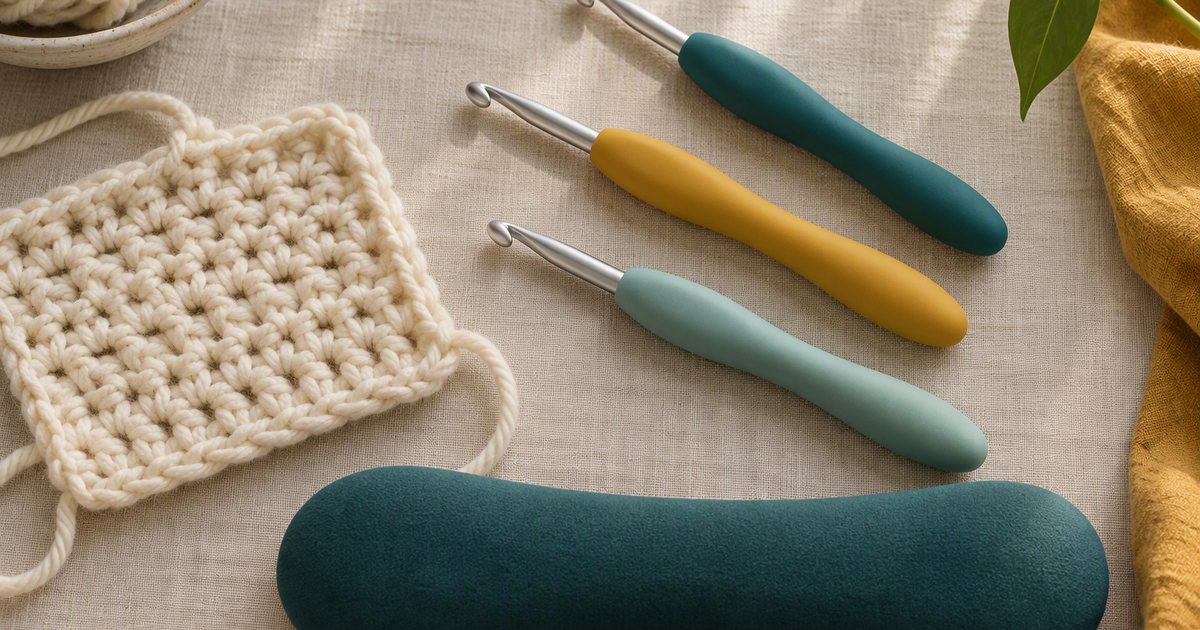
Traditional metal hooks are narrow, slick cylinders that force your hand into a tight pinch grasp. Maintaining that tiny diameter pinch requires continuous muscle contraction, which accelerates fatigue. Ergonomic crochet hooks solve this by adding a contoured, vulcanized rubber or silicone handle that substantially thickens the grip area.
A thicker handle fills the void in your palm, letting you secure the hook with minimal closing pressure. When shopping for ergonomic tools, look for handles with a flat thumb rest and a gradual taper. If you prefer wooden hooks, smooth beechwood or birch options offer natural warmth and slight flex, which absorbs vibration better than cold, rigid steel.
Practical Habits for Pain-Free Crocheting
Ergonomics extend beyond your hands to your entire sitting posture. Slouching over your work strains your neck and pinches the nerve pathways running down into your arms. Rest a firm throw pillow on your lap while you work to elevate your forearms, which keeps your elbows bent at a healthy ninety-degree angle and unloads weight from your shoulders.
Incorporate deliberate physical pauses into every project session to keep your soft tissues resilient and well-oxygenated. Taking small preventative steps before pain sets in is the secret to crocheting happily well into your later years.
- Take a mandatory two-minute break every thirty minutes to open and spread your fingers wide.
- Gently roll your shoulders backward and tilt your head side to side to loosen trapped neck tension.
- Warm up cold hands in warm water or with fingerless gloves before picking up your hook.
- Stop immediately if you feel sharp, burning nerve pain or tingling in your fingertips.
Frequently asked questions
How do I know if I am gripping my crochet hook too tightly?
Check your knuckles while working: if the skin turns white or feels rigid to the touch, you are clenching too hard. Another clear sign is finding indentations pressed into your fingertips or feeling soreness at the base of your thumb after just fifteen minutes.
Can I switch from pencil grip to knife grip after years of crocheting?
Yes, you can retrain your muscle memory at any stage. Expect your tension to be uneven for the first few swatches, but working on a simple project like a basic dishcloth will help your hands adapt within a few days.
Why does my yarn-holding hand hurt more than my hook hand?
Your yarn hand tends to stay frozen in an isometric clench to control tension, while your hook hand moves through a dynamic range of motion. Static muscle holds fatigue tissues much faster than active movement.
Do ergonomic hooks really help with arthritis and carpal tunnel?
Yes. The larger handle diameter reduces the pinch angle of your fingers, which lessens pressure on the carpal tunnel and reduces friction across arthritic knuckle joints.
How often should I take breaks when crocheting?
Set a timer to pause every 30 to 45 minutes. Put your project down, stretch your fingers, rotate your wrists in slow circles, and stand up to reset your posture.