Easy Crochet Water Bottle Holder Pattern
Keep your hands free and stay hydrated with this quick, practical crochet water bottle holder featuring a sturdy crossbody strap.
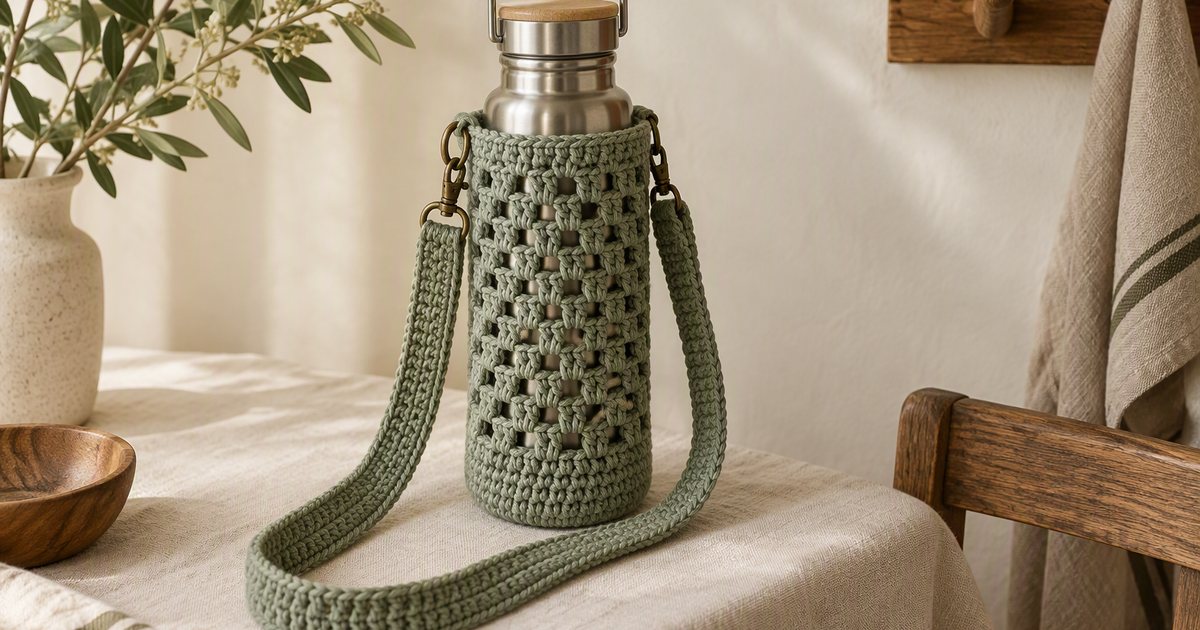
AI-generated illustration, not a photograph of the finished item. About our images
Materials and Gauge Check
Choosing the right yarn is the secret to a holder that does not sag when your bottle is full. I always recommend a 100% mercerized cotton yarn because it has minimal stretch and holds its shape well against condensation. Avoid heavy wools or acrylics that tend to stretch out under weight.
You will need a US G/6 (4.0mm) crochet hook, a tapestry needle for weaving in ends, and a stitch marker to keep track of your rounds. The finished pouch comfortably fits standard 20 to 32-ounce reusable water bottles, but I will show you how to easily adjust the base diameter if yours is wider.
- 1 ball of worsted weight cotton yarn
- US G/6 (4.0mm) crochet hook
- Locking stitch marker and yarn needle
Crocheting the Flat Base
We start at the very bottom of the holder by working in continuous rounds without joining. Make a magic ring, then work 6 single crochets into the ring and pull it tight. Place your stitch marker in the first stitch of the round and move it up as you go.
For round two, work 2 single crochets in each stitch around for a total of 12 stitches. Continue increasing by 6 stitches each round—such as 1 single crochet, then 2 single crochets in the next—until your circle matches the flat bottom diameter of your specific water bottle.
- Rnd 1: 6 sc in magic ring (6)
- Rnd 2: 2 sc in each st around (12)
- Rnd 3: [1 sc, 2 sc in next st] repeat around (18)
Building the Holder Body
Once your base reaches the correct width, stop increasing entirely. For the next round, work 1 single crochet in the back loop only of each stitch to create a sharp, clean corner edge where the base meets the vertical wall of the holder.
After that transition round, simply work 1 single crochet in both loops of every stitch for all remaining rounds. Continue working in a spiral until the body reaches just below the neck of your water bottle, usually about 7 to 9 inches tall depending on your bottle size.
- Work 1 round in back loops only (BLO) to turn the corner
- Work standard single crochet in both loops for all body rounds
- Stop about 1 inch below the bottle opening
Creating and Attaching the Crossbody Strap
A strong crossbody strap needs to resist stretching over time. Instead of a basic chain, we will make a foundation single crochet strap or a sturdy reinforced half double crochet band that measures roughly 40 inches long, or whatever length sits comfortably across your hip.
Pin the two ends of your finished strap securely to opposite sides of the top edge of your bottle holder. Use a length of matching yarn and a whipstitch to sew back and forth through the stitches multiple times, ensuring the attachment points can bear the full weight of a liquid-filled bottle.
- Chain 3 or use foundation stitches for a non-stretch strap
- Make strap approximately 40 to 44 inches long
- Sew securely to opposite sides of the top rim
Frequently asked questions
What yarn is best for a water bottle holder?
100% cotton yarn is essential because it is durable, machine washable, and does not stretch out under the heavy weight of water like acrylic yarn does.
How do I adjust the size for a wider bottle?
Simply keep adding increase rounds to the flat base until the circle matches the diameter of your bottle bottom, then stop increasing and work straight up.
Should I join rounds or work in a spiral?
Working in continuous spiral rounds is recommended for this pattern because it leaves no visible seam running up the side of your finished holder.
How do I keep the strap from stretching out?
Use tight tension, choose cotton yarn over wool, and consider working half double crochet or foundation stitches instead of a basic chain for the strap.
Can I wash this water bottle holder?
Yes! Since you are using cotton yarn, you can toss the holder right into the washing machine on a gentle cycle and let it air dry flat.