Free Crochet Market Bag Pattern (Mesh Net Tote)
An open-mesh net bag with a diamond lattice look, built to actually carry groceries rather than just look the part.
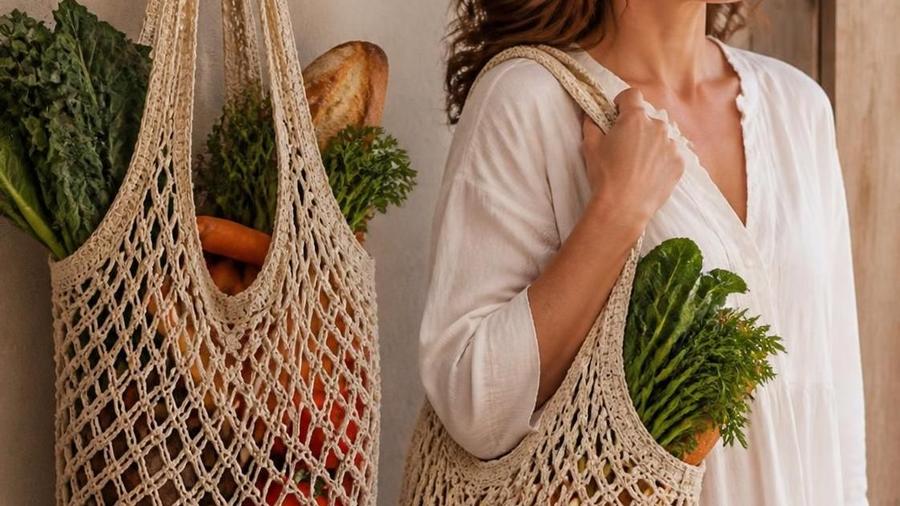
My first attempt at a market bag used the same acrylic yarn I had leftover from a blanket project, on the assumption that yarn is yarn and a bag is just a smaller version of any other crocheted thing. Three grocery trips later, that bag had stretched into something closer to a floor-length pouch, permanently misshapen from the weight of a single trip's worth of produce. Acrylic simply doesn't recover its shape once stretched under real load the way cotton does, and a market bag spends its whole working life under load.
Once I switched to a sturdy cotton yarn, the exact same mesh pattern held its shape trip after trip. The open V-stitch lattice that gives this bag its see-through, breathable look isn't just decorative either: it's also what makes the bag foldable down to almost nothing when empty, since there's no solid fabric bulk to it at all. The whole bag, base included, is worked in continuous rounds with no seams to weaken under weight, except at the strap, which gets deliberately reinforced since that's the one point genuinely under constant stress.
Below is the full pattern in US terms, worked from a flat oval base upward through the mesh body to a doubled, reinforced strap, along with the yarn-choice reasoning that actually matters here more than in most patterns, plus sizing notes for adapting this into a bread bag, a produce-specific bag, or a beach tote.
If you've made one of our other flat-base projects before, our flat circle technique guide covers the same underlying increase logic this bag's oval base relies on, just applied to a round rather than an oval shape; understanding one makes the other much more intuitive.
Materials
- About 250–300 yards of worsted-weight cotton or cotton-linen blend yarn
- 4-4.5mm crochet hook
- Yarn needle, scissors, stitch marker
Abbreviations (US terms)
| Abbr. | Means |
|---|---|
| ch | Chain |
| sc | Single crochet |
| dc | Double crochet |
| st(s) | Stitch(es) |
See our abbreviations glossary for the full list including UK terms.
Gauge
Gauge is not critical for this pattern, but keep your mesh chain-spaces consistent in size throughout for an evenly-holed lattice.
Notes
- Worked in continuous rounds throughout (no joining), except the strap, which is worked flat.
- Use a stitch marker to track round starts on the base and body.
- The oval base's round count can be adjusted for a wider or narrower bag; see the sizing section.
Pattern
Chain 9. Sc in 2nd ch from hook and each ch across to last ch, 3 sc in last ch. Continue along the opposite side of the foundation chain, sc in each ch back to the start, 2 sc in first ch to close the round. (18 sts)
Round 2: sc in each of the 7 straight-side sts, [inc] x3 around the curved end, sc in each of the 7 straight-side sts on the other side, [inc] x3 around the other curved end. (24 sts) Rounds 3-4: continue the same pattern, increasing only at the two curved ends while working the straight sides even, until the base reaches your desired width (about 4 rounds total for a standard market bag base).
Ch 3 (counts as first dc). *Skip 1 st, dc in next st, ch 1* repeat around, joining with a slip stitch to the top of the starting ch-3. This is the V-stitch mesh repeat that forms the whole visible body of the bag.
Ch 3, dc in the first ch-1 space from the previous round. *Ch 1, skip to next ch-1 space, dc in it* repeat around. Join with a slip stitch. Repeat this round until the bag measures about 16in / 41cm tall from the base, or your desired depth.
Work 1 round of sc evenly around the top opening for a clean, finished edge. Join, fasten off.
Chain 121. Sc in 2nd ch from hook and each ch across (120 sts). Ch 1, turn, sc across for 2 more rows. Fasten off, leaving a long tail. Fold the strap into thirds lengthwise and single crochet through all layers along the open edge, joining them into one thick, doubled strap.
Position one end of the strap at the top edge on one side of the bag and sew it securely in place. Work 1 extra round of sc directly over this attachment point, through both the strap end and the bag's top edge, for reinforcement. Repeat at the other end on the opposite side of the bag.
Why fiber choice matters more here
Most crochet patterns treat yarn weight as the main decision and fiber as a secondary preference. A market bag reverses that priority. Because this bag is specifically going to carry real, repeated weight, fiber is doing structural work that decoration-focused projects never ask of it. Cotton's low stretch and good recovery are exactly what keep the bag's shape intact trip after trip; acrylic's greater stretch, an advantage in a stretchy sweater, is a liability here, since a stretched-out acrylic mesh doesn't spring back once the groceries come out.
A cotton-linen blend goes a step further, adding a bit more structure and crispness than pure cotton alone, which some crocheters prefer for a bag that holds its shape even when empty rather than collapsing completely flat. A jute-cotton blend is the sturdiest option of all, worth considering specifically for a bag meant for consistently heavy loads like a weekly full grocery run rather than a quick trip for a few items.
It's worth resisting the temptation to substitute whatever cotton happens to be on hand without checking its ply and thickness first. A very thin, single-ply cotton, even if technically cotton, can still stretch more than expected under weight simply because there's less fiber holding each strand together; a plied, sturdier cotton yarn gives a noticeably more reliable result for this specific project.
Adapting the size for different uses
This pattern's base-to-body ratio is easy to shift for different jobs. For a wider, shorter bag suited to bread or a rolled beach towel, work 1-2 extra rounds on the oval base before starting the mesh body, and stop the body a few rounds earlier than written. For a narrower, taller bag suited to a single bunch of produce, a baguette, or a wine bottle, use fewer base rounds and continue the mesh body longer. The V-stitch repeat itself never changes, only how many rounds of base versus body you work before finishing the top edge.
Washing & care
Wash in cold water by hand or on a gentle machine cycle, and always lay flat to dry rather than using a machine dryer, which can shrink cotton and distort the mesh pattern's even spacing. A quick reshape by hand while still damp, gently stretching the mesh back to its original proportions, helps the bag dry back to its intended shape rather than a slightly puckered one. Give the strap a firm tug in both directions while reshaping too, since it tends to hold a slight crease from folding if left untouched.
Durability fixes
Fix: use cotton or a cotton-blend yarn, not acrylic, which is this pattern's whole basis; acrylic simply won't recover its shape once stretched under real weight.
Fix: work an extra reinforcing round of single crochet directly through both the strap end and the bag's top edge at each attachment point, not just a handful of sewing stitches.
Fix: reduce the chain-space size in the V-stitch repeat (ch 1 becomes too loose for very small items like berries or garlic; consider working the mesh slightly denser for a produce-specific version of this bag).
Fix: work 2 more rounds on the oval base before starting the sides, giving the bag a wider, more stable bottom footprint to rest on.
Fix: wash in cold water only and lay flat to dry; a hot wash or machine dryer is what causes most of the shrinkage in cotton market bags.
Our pick
Lion Brand 24/7 Cotton Yarn
A sturdy, machine-washable worsted-weight cotton with good stitch definition and low stretch, well suited to a bag that needs to hold real weight.
View on Amazon →Market bag FAQ
What's the best yarn for a market bag that needs to hold real weight?
Cotton or a cotton-linen blend is the standard choice, since it holds its shape under load and doesn't stretch out permanently the way acrylic does. A jute-cotton blend adds even more structure for a bag meant to carry heavier loads regularly on a consistent basis.
How do I adjust the size for bread, produce, or a beach towel?
Work more rounds of the oval base for a wider, shorter bag suited to bread or a rolled towel, or fewer base rounds with more body rounds for a taller, narrower bag better suited to a single bunch of produce or a wine bottle. The mesh repeat itself doesn't need to change, just the proportions of base to body.
Does this bag shrink when washed, and how do I prevent it?
Cotton can shrink slightly in hot water or a machine dryer. Wash in cold water and lay flat to dry rather than machine drying, which keeps shrinkage minimal and protects the mesh pattern's shape.
How much weight can this bag actually hold?
A well-made cotton market bag with a reinforced strap comfortably holds a typical grocery run, roughly 10-15lbs, without stretching permanently. Heavier loads are possible but will stretch the mesh more over time, which is normal wear rather than a flaw. If you regularly carry heavier loads than this, the jute-cotton blend mentioned above is worth the extra sturdiness.
What are the different mesh pattern options besides V-stitch?
Filet mesh (a grid of small open squares) gives a more uniform, tighter grid than V-stitch's diagonal diamonds, and Solomon's knot mesh gives longer, more dramatic open loops. All three produce a see-through, breathable bag; V-stitch is used here for its balance of speed and hole size.
Is this a good eco-friendly or gift option?
Yes, a reusable cotton market bag is a genuinely practical alternative to single-use produce bags, and it makes a well-received gift for anyone who already shops with reusable totes, since a handmade one stands out from the mass-produced mesh bags sold at most grocery stores.
How much yarn do I need?
About 250-300 yards of worsted-weight cotton or cotton-linen blend for the size given in this pattern, including the reinforced strap.
CrochetGuides is a participant in the Amazon Services LLC Associates Program. As an Amazon Associate we earn from qualifying purchases, at no extra cost to you.