How to Read a Crochet Pattern Without Panicking
Abbreviations, gauge, and repeats explained the way we wish someone had explained them to us.
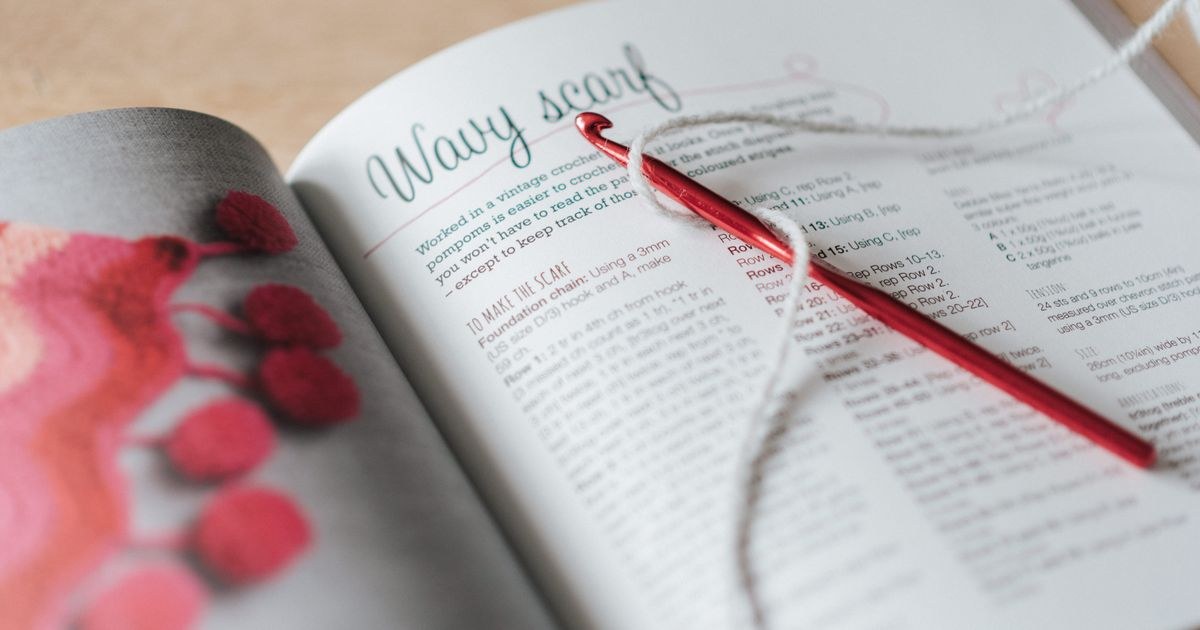
In twelve years of teaching, I've watched the same thing happen in every beginner class: someone pulls up a pattern, stares at the first line for thirty seconds, and quietly decides the problem is them. It isn't. A pattern is just a recipe, written as compactly as the designer could manage, and the shorthand — the abbreviations, asterisks, and numbers in brackets — exists to save space, not to gatekeep anyone. Once you learn to read that shorthand, the panic mostly disappears, and you start actually following patterns instead of staring at them.
This guide covers the pieces that trip people up most: the abbreviations themselves, what gauge is actually measuring, how to read a repeat, and how to catch a mistake early by checking your stitch count as you go. If reading a pattern has ever made you feel like you're missing something obvious, this page is for you.
Before you pick up the hook
Every pattern worth using has a short block of notes before the instructions start, and it's the part almost everyone skips. It usually covers three things worth reading first: which terms it uses (US or UK — see the FAQ below if you're not sure which you're looking at), any special stitches or abbreviations unique to that pattern that aren't in the standard list, and the finished size or gauge the designer worked to. Skipping this section is the single most common reason a pattern feels confusing five minutes in — you're usually missing a definition the designer assumed you'd already seen.
If a term in the notes still means nothing to you, our abbreviations glossary lists the full US and UK stitch vocabulary in one place, including the less common ones like fpsc and bphdc that tend to hide in the fine print.
Common abbreviations
| Abbreviation | Means |
|---|---|
| ch | Chain |
| sc | Single crochet |
| dc | Double crochet |
| hdc | Half double crochet |
| sl st | Slip stitch |
| st(s) | Stitch(es) |
| rep | Repeat |
| sk | Skip |
| inc / dec | Increase / decrease |
Don't try to memorise all of this at once — you'll pick up the common ones within your first project simply from repetition. The five you'll meet first are ch, sc, dc, sl st, and inc; keep this table open in another tab for the rest and look things up as you go. Every crocheter I know still checks a glossary occasionally for the rare ones, so it's a habit, not a crutch.
What gauge actually means
Gauge tells you how many stitches and rows fit into a set square, usually 10cm/4in, when using the hook and yarn the pattern recommends. It exists because everyone's tension is slightly different — two people using the same hook and yarn can produce noticeably different-sized results.
For anything where exact size matters (garments, amigurumi with fitted parts), crochet a small gauge swatch first. For anything forgiving (scarves, blankets), you can usually skip it.
To check it, crochet a square a bit bigger than 10cm, lay a ruler across the middle, and count the stitches and rows in that 10cm. If you have too many stitches, your work is coming out smaller than intended, so go up half a hook size; too few, and you go down. A swatch that's close but not exact is sometimes still usable, but if it's way off and the size matters, the fix is always the hook, not your technique — more on that in our guide to fixing project size.
Reading repeats: asterisks and brackets
When you see something like:
*sc in next st, ch 1, skip 1 st; rep from * to end
Everything between the asterisks is one repeating unit. You work it over and over until you reach the end of the row, rather than the pattern spelling out the same instruction fifteen times.
Brackets work the same way but usually with a stated repeat count, like [dc, ch 1] x4 — do the bracketed steps exactly four times.
Sometimes you'll see brackets nested inside asterisks, or a repeat that says something like *dc in next st, [hdc, dc] in next st; rep from *. Read the innermost instruction first, then work outward, exactly the way you'd solve a maths problem with parentheses. When a repeat doesn't seem to end cleanly at the row's edge, that's usually a sign you've missed one step inside the repeat — count back to the last asterisk rather than unpicking the whole row.
Reading a stitch count
Most rows end with a number in parentheses, like (12 sts). This tells you how many stitches you should have after finishing the row. Checking this every row — not just at the end of a project — is the fastest way to catch a missed stitch before it compounds.
Let's read a real line together. Row 2: ch 1, *sc in next st, inc; rep from * 3 times, sc in last st (12 sts). Translated, it says: chain one to turn, then repeat "single crochet, then increase" three times, and finish with a single crochet in the final stitch. The (12) is your safety check — if you count and you're at 11 or 13, you know exactly which row to look at. Being able to unpack a line like this in your head is the entire skill; once you can, every pattern in existence opens up.
Common reading mistakes
The Complete Crochet Stitch Dictionary
200+ stitches with charts — handy once you've got the abbreviations down.
A walkthrough of a written pattern line by line, useful for seeing how abbreviations translate into stitches.
Frequently asked questions
What does gauge mean in a crochet pattern?
Gauge tells you how many stitches and rows should fit into a set measurement, usually 10cm or 4 inches, when using the recommended hook and yarn. Matching it ensures your finished piece comes out the size the pattern intends.
What do the asterisks and brackets in a pattern mean?
Asterisks and brackets mark a section that repeats. Everything between the marks is worked as many times as stated, so you don't have to read the same instruction written out over and over.
Why doesn't my stitch count match the pattern?
The most common cause is a missed or extra stitch at the start or end of a row. Count your stitches at the end of every row while you're learning, rather than waiting until the end of the project to check.
What's the difference between US and UK crochet pattern terms?
The same stitch name means a different stitch in each system, most famously UK "double crochet" being the same stitch as US "single crochet." Always check which terms a pattern uses before you start, since working the wrong stitch height throughout a project is a very easy mistake to make.
What is a turning chain and why does it matter?
A turning chain is one or more chain stitches worked at the start of a new row to bring your hook up to the correct height for that row's stitch. Depending on the stitch, that turning chain may or may not count as your first stitch of the row, and getting that wrong is one of the most common causes of a stitch count drifting off over several rows.
How do I know if a pattern is written in US or UK terms?
The quickest clue is the word "single crochet." US patterns use it constantly, while UK patterns don't have that stitch at all — what the UK calls double crochet is the US single crochet. Many patterns also state it explicitly in the notes. When in doubt, check the stitch heights against our abbreviations glossary before you start.
What does "work in the round" mean in a pattern?
It means you crochet in a continuous spiral or in joined circles rather than turning at the end of each row. Patterns worked in the round are common for hats, amigurumi, and granny squares, and they usually tell you to place a stitch marker in the first stitch of each round so you can keep track of where the round began. Our crocheting in the round guide covers it in full.
CrochetGuides is a participant in the Amazon Services LLC Associates Program. As an Amazon Associate we earn from qualifying purchases, at no extra cost to you.