Free Mermaid Tail Blanket Crochet Pattern
Overlapping crocodile-stitch scales in a teal ombre, narrowing into a ribbed fin — the most requested pattern in my classes every single summer.
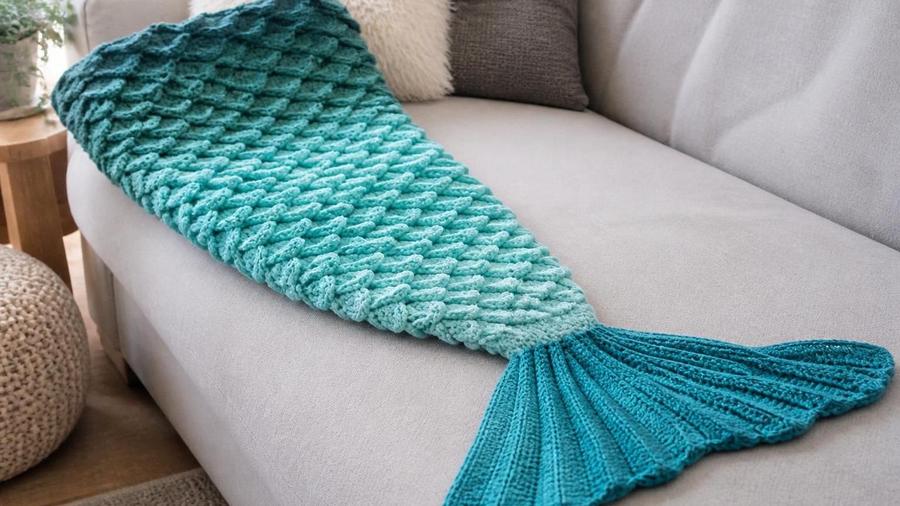
I put off making a mermaid tail blanket for a long time because crocodile stitch photos online always looked like something out of a stitch dictionary I'd need a diagram to decode. Then a student's daughter asked for one for her birthday, with three weeks' notice and zero flexibility on the deadline, and I sat down to actually learn it properly instead of admiring it from a distance. What I found is that crocodile stitch is one of those techniques that looks far more intricate than it actually is: it's just a V-stitch foundation with extra double crochet stitches worked down each post, repeated in an offset pattern so the "scales" overlap like real fish scales.
The blanket itself is two distinct sections stitched as one continuous piece: the scaled body, worked in a gradually shifting teal ombre, and the fin at the narrow end, worked in a different stitch entirely to create the flared, ribbed look of an actual tail fin. It's a genuinely striking project, and one that gets more comments per hour of work than almost anything else I teach.
Below is the full pattern in US terms, with my honest notes on how the scale rows actually work, how to build a smooth ombre gradient rather than obvious stripes, and how to shape the fin so it flares convincingly instead of looking like a plain rectangle with a point on the end. If double crochet is still new to you, our basic crochet stitches guide covers it from the start.
Materials
- About 950 yards total of soft worsted-weight yarn: roughly 700 yards across 3–4 graduating teal shades for the body, plus 250 yards of a deeper teal or navy for the fin
- 5mm (US H-8) crochet hook
- Stitch markers
- Yarn needle and scissors
Abbreviations (US terms)
| Abbr. | Means |
|---|---|
| ch | Chain |
| dc | Double crochet |
| sc | Single crochet |
| BLO | Back loop only |
| V-st | V-stitch: (dc, ch 1, dc) in the same stitch or space |
| st(s) | Stitch(es) |
Gauge
4 V-stitches and 2 scale rows measures about 4in / 10cm square with a 5mm hook and worsted yarn. Crocodile stitch gauge is easiest to check by measuring across a small swatch after the scale row, not the plain V-stitch foundation.
Notes
- The scale body is worked over an even number of V-stitches; we use 20 across for this size.
- Each scale row is offset from the one before it by half a V-stitch, which is what makes the scales overlap rather than stack in a plain grid.
- Change shade every 6–8 rows on the body for a gradual ombre rather than an abrupt stripe.
- The fin uses a different stitch (single crochet, back loop only) worked in a deeper contrast shade, increased across a few rows to flare the shape.
Pattern
With your lightest teal shade, chain 41. Skip the first 2 chains, then work (dc, ch 1, dc) — one V-stitch — into the 3rd chain from the hook. Skip 1 chain, work a V-stitch into the next chain. Repeat across, ending with a V-stitch in the last chain. Turn. (20 V-stitches)
Chain 1. Working down the post of the first V-stitch's first dc, work 5 dc evenly spaced down the post, then work 5 more dc down the post of that same V-stitch's second dc — this pair of 5-dc fans forms one scale, curving around the V-stitch's chain-1 space. Skip the chain-1 space between V-stitches and repeat down each V-stitch's posts across the row. Turn.
Chain 3 (counts as first dc). Work a V-stitch into the gap between each pair of scales from the previous row, offsetting the placement by half a V-stitch so the next scale row's fans will nestle between, rather than directly on top of, the scales below. Turn.
Continue alternating a scale row and a V-stitch return row, changing to the next lighter or darker teal shade every 6–8 rows, until the scaled body measures about 30in / 76cm. This gives roughly 30 total rows, adjustable for your preferred length.
Switch to your deepest teal or contrast shade. Work 1 row of single crochet in each stitch and chain-1 space across the last scale row, evening the edge out into a flat row of even stitches. Turn.
Chain 1, single crochet in the back loop only across, increasing evenly by adding 2 extra single crochet stitches spaced across the row (not at the very edges) to flare the fin's width outward. Turn. Repeat for 3 rows total.
Work 4 more rows of single crochet in the back loop only with no further increases, letting the ribbed texture read clearly. Fasten off and weave in all ends.
How crocodile stitch actually works
The part that confuses most people learning crocodile stitch for the first time is that the "scales" aren't worked into stitches in the usual sense — they're worked down the vertical post of a double crochet stitch, the same technique used in front-post and back-post stitches. Each V-stitch from the foundation row has two posts (the two dc legs of the V), and each post gets its own fan of 5 double crochet worked directly around it, angled to curve outward. Two fans from the same V-stitch, sitting side by side, form one scale.
The offset return row is what makes the finished fabric look like real, overlapping scales rather than a plain grid of fans. By placing the next row's V-stitches in the gaps between the previous row's scales, the following scale row's fans end up centred between, and slightly overlapping, the scales below them — the same brick-like offset used in masonry or shingle patterns.
Building a smooth ombre
A convincing ombre depends more on how often you change shade than on how many shades you own. Changing colour every 6 to 8 rows, using 3 to 4 shades that graduate smoothly from light to dark, reads as a gradient; changing less often, or jumping between only 2 very different shades, reads as stripes instead. If your chosen yarn line doesn't offer enough in-between shades, holding one strand of a lighter shade together with one strand of a darker shade for a few transitional rows is a reliable trick for smoothing an otherwise abrupt jump. Our guide to changing colors in crochet covers the mechanics of a clean colour join, which matters even more here since a messy join is much more visible against a gradient than against a single solid colour.
Sizing for an adult
This pattern is written for a child-to-teen length of about 44 inches. For an adult, extend the scaled body by roughly 10 to 12 more rows before starting the fin transition, aiming for a total body length closer to 40 inches before the fin begins, and widen the foundation row to 24 V-stitches for a roomier fit through the hips. Add an extra shade or two to the ombre sequence so the wider, longer body still transitions gradually rather than needing longer runs of each colour.
Care & washing
Check your yarn's washability before you start, since a blanket this labour-intensive is worth protecting. Hand wash or use a gentle machine cycle in a mesh bag, and always dry flat, since the weight of the scale texture holds water longer than a plain stitch and can stretch if hung. Our guide to washing crochet items covers fiber-specific care in more depth.
Common mistakes & fixes
Fix: the 5-dc fans are worked around the vertical post of each dc, the same motion as a front-post stitch, not into the top of the stitch itself. If your scales look flat rather than raised, check this first.
Fix: each return row's V-stitches should sit in the gaps between the previous row's scales, not directly above them. This half-scale offset is what creates the overlapping, brick-like scale pattern.
Fix: change shade every 6 to 8 rows using several graduating colours rather than 2 very different ones, and consider a transitional row or two holding two shades together at each change.
Fix: space your increase stitches evenly across the row rather than clustering them, and keep the increases away from the very first and last stitch so the fin's side edges stay straight.
Fix: always work one plain row of single crochet across the last scale row first. It converts the uneven scale edge into a consistent stitch count the fin rows can build on cleanly.
Our pick
Caron Simply Soft Yarn (multi-shade teal pack)
An affordable worsted-weight yarn available in enough distinct teal and blue-green shades to build a genuinely smooth ombre without hunting across different yarn lines.
View on Amazon →Frequently asked questions
What stitch is used for a mermaid tail blanket?
Crocodile stitch, sometimes called scale stitch, is the standard choice for the overlapping scale texture on a mermaid tail. It's worked over a foundation of V-stitches, with additional stitches crocheted down each V's two posts to form individual scales.
Is crocodile stitch hard to learn?
It looks more complex than it is. The foundation row is just V-stitches, and each scale is a repeated sequence of double crochet stitches worked down the posts of two adjacent V-stitches. The pattern is highly repetitive once you've worked the first few scales, though it is slower than a plain stitch.
How do you create an ombre effect in crochet?
Use several skeins of the same yarn line in graduating shades of one colour, and change to the next shade at set intervals, such as every 6 to 8 rows. Changing gradually rather than in one abrupt jump is what creates the smooth gradient look rather than distinct stripes.
How is the fin shaped on a crochet mermaid tail blanket?
The fin is usually worked separately from the scale body, in a different stitch that flares out and often in a contrasting or deeper shade. This pattern uses ribbed single crochet worked in the back loop, increased evenly across a few rows to create the flared fin shape.
What size should a mermaid tail blanket be?
For a child, a finished length of about 40 to 45 inches is typical; for an adult, 55 to 60 inches. This pattern is written for a child-to-teen size around 44 inches long, with notes on lengthening it for an adult.
How much yarn does a mermaid tail blanket use?
This child-sized pattern uses roughly 900 to 1,000 yards total across the ombre shades and the fin colour, typically 4 to 5 skeins. An adult-sized version can need 1,400 yards or more.
CrochetGuides is a participant in the Amazon Services LLC Associates Program. As an Amazon Associate we earn from qualifying purchases, at no extra cost to you.