Free Crochet Slippers Pattern for Beginners
A cozy sole-and-sides construction, built from the same flat circle and straight rounds used across our beginner patterns.
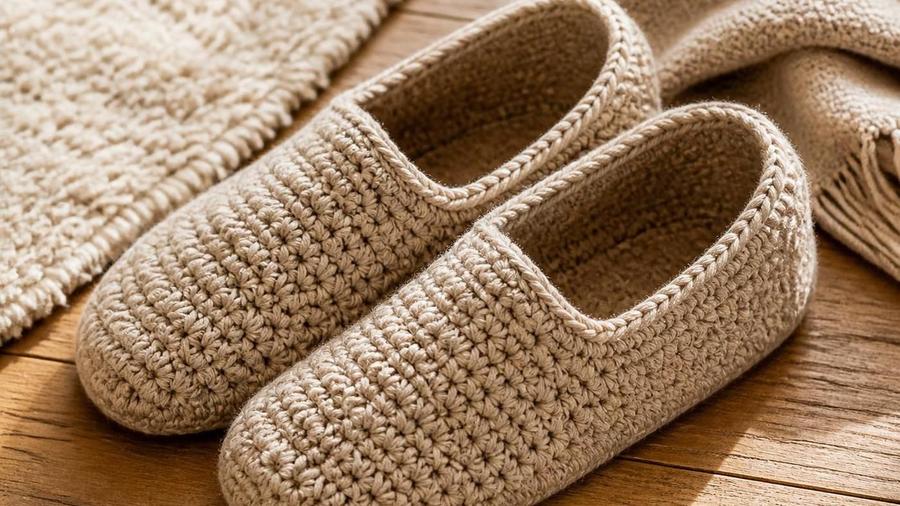
In my classes, slippers are the project people start after a scarf, and the mistake I see most often is the same one I made myself years ago: skipping the foot measurement and trusting the round counts. I once crocheted a pair for my sister's birthday using my own foot as the guide, and she opened the box to find slippers a full size too small — wearable only as a very determined squeeze. Now I make every student trace a foot onto paper before they chain anything, and the slippers fit on the first try almost every time. It's the single most useful habit this pattern will teach you.
Materials
- 2 skeins worsted-weight yarn (about 150–180 yards)
- 5.0mm (US size H) crochet hook
- Stitch marker, to track the start of each round
- Scissors
- Yarn needle, for weaving in ends
- Optional: fabric paint or suede sole patches for grip
Abbreviations (US terms)
| Abbr. | Means |
|---|---|
| ch | Chain |
| sc | Single crochet |
| st(s) | Stitch(es) |
| inc | 2 sc in same stitch (increase) |
| rnd(s) | Round(s) |
See our abbreviations glossary for the full list including UK terms.
Gauge
14 sc and 16 rows measures about 4in / 10cm square with a 5.0mm hook and worsted yarn. Fit depends directly on the sole chain length — measure the wearer's foot before starting for the best result.
Notes
- Written in US terms, worked in a continuous spiral — use a stitch marker to track round starts, same technique as our baby booties pattern.
- Makes one slipper; repeat the entire pattern once more for a matching pair.
- For a firmer, warmer sole, work the first sole round through the back loop only, then continue as written.
Pattern (make 2)
Ch 13. Starting in 2nd ch from hook, sc 11, work 3 sc in last ch, then sc 11 down the other side of the chain, work 2 sc in the last ch. Place marker. (28 sts)
Inc, sc 10, inc 3 times, sc 10, inc twice. (34 sts)
Sc in every st around, no increases. (34 sts)
Sc in every st around for 9 rounds, working through the back loop only on round 4 for a defined edge between sole and sides. (34 sts each round)
Fasten off, leaving a long tail. Weave the tail through the front loops of the last round and pull gently to slightly gather the opening, leaving enough space to fit the foot comfortably. Weave in the end.
A tutorial on crocheting ribbed slippers, useful for seeing the sole and upper construction joined together.
Sizing for different feet
The pattern as written (Ch 13, 28 starting stitches) makes an adult medium, roughly a 9–10in / 23–25.5cm foot. To size up or down, adjust the starting chain in Round 1 rather than the increase rounds — it's the simplest number to change and keeps the rest of the pattern identical. If this is your first time working in continuous rounds, our how to crochet in the round guide walks through the technique before you begin.
For each half-inch longer than medium, add 2 chains to the starting chain (so Ch 15 for one half-inch up, Ch 17 for a full inch up), and work one extra plain round in the sides section to keep the proportions balanced. For a smaller foot, remove 2 chains per half-inch instead, and drop a round from the sides. The increase pattern in Round 2 stays the same — you're only changing how long the oval starts out, not how it's shaped.
Width is a separate adjustment from length: if the foot is narrow or wide rather than short or long, go down or up a hook size (4.5mm or 5.5mm) instead of changing the stitch counts, and check the gauge swatch again before committing to a full slipper.
Common mistakes & fixes
Fix: flip the finished slipper over and apply dots of puffy fabric paint to the sole in a grid pattern, letting it cure fully (usually 24 hours) before wearing.
Fix: measure the foot before starting Round 1 and adjust the starting chain by 2 stitches per half-inch, as described above, rather than guessing and hoping the round counts work out.
Fix: for a tight opening, gather the finishing round more loosely or add one stitch evenly around; for a loose one, gather it tighter or work an extra single crochet round through the back loop only before fastening off.
Our pick
Cotton worsted-weight yarn, 3-pack
Enough yarn for a pair of slippers with extra left over, in colours suited to a cozy indoor project.
View on Amazon →Frequently asked questions
How do I size crochet slippers for different feet?
Measure the length of the wearer's foot and add one more round to the sole for each half-inch longer than the base size, or remove a round for a smaller foot.
What yarn makes the warmest crochet slippers?
A wool or wool-blend worsted-weight yarn adds more warmth than acrylic, though acrylic is easier to machine wash and still works well for indoor use.
How do I stop crochet slippers from being slippery on hard floors?
Puffy fabric paint applied in dots to the sole and left to dry fully creates a simple non-slip grip, or purpose-made suede sole patches can be sewn on for a sturdier finish.
How do I wash crochet slippers without ruining the shape?
Hand wash in cool water with a mild detergent, squeeze out excess water without wringing, and reshape by hand before laying flat to dry away from direct heat, which can warp the sole and shrink wool blends.
What if the top opening of the slippers is too tight or too loose?
For a too-tight opening, work the finishing round with a larger hook or add one extra stitch evenly around; for a too-loose opening, drop to a smaller hook or work a round of single crochet through the back loop only to snug it in.
Can I make these slippers with a non-slip sole from the start?
You can work the sole in a rubber-backed yarn or hold a strand of grippy acrylic alongside your main yarn for the sole rounds only, then continue with the main yarn for the sides. Applying puffy fabric paint to the finished sole is the simplest option if you've already completed the slippers.
Are these crochet slippers suitable for outdoor wear?
They're designed for indoor use and won't hold up well on wet or rough ground, but a sturdier cotton or a wool-blend yarn plus a suede sole patch will make them usable for quick trips to the porch or around the garden.
CrochetGuides is a participant in the Amazon Services LLC Associates Program. As an Amazon Associate we earn from qualifying purchases, at no extra cost to you.