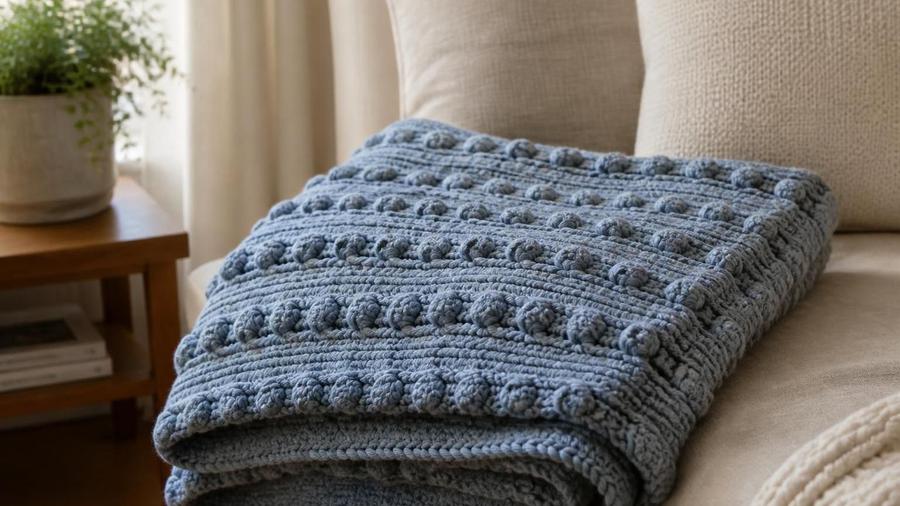
Rows of raised bobbles marching across a dusty blue background — the kind of texture that photographs beautifully and feels even better under your hand.
Updated 2026 · US terms · About 40 x 50in / 102 x 127cm
Bobble stitch was the first textured stitch I ever taught myself from a book rather than a class, and I remember being convinced I was doing something wrong for the first several bobbles, because they kept popping to the back of the fabric instead of the front. Nobody had told me the one small trick that fixes this: after you close a bobble, you gently push it toward you, toward the side of the fabric you want it to sit on, before working the next stitch. It took thirty seconds to learn and completely changed how confident I felt about the whole technique.
This throw uses that same bobble, worked in dusty blue, in rows spaced across a plain double crochet background so each raised bump has room to stand out rather than crowding its neighbours. It's a slower project than a plain blanket the same size, since every bobble takes several times longer than an ordinary stitch, but it's also one of the most satisfying textures to work through an evening, since you can feel each bobble form under your fingers as you close it. It's the project I hand to students who've told me they find plain rows a little dull to work on their own, since there's a small, tactile reward built into the pattern every few stitches.
Below is the full pattern in US terms, with the bobble construction explained step by step, my notes on the specific trick that keeps bobbles popping to the right side consistently, and the mistakes that make a bobble row look messy instead of crisp. If double crochet itself is new to you, our basic crochet stitches guide covers it from the start.
About 1,050 yards (roughly 6 skeins) of worsted-weight yarn in dusty blue
5.5mm (US I-9) crochet hook
Stitch markers
Yarn needle and scissors
Abbreviations (US terms)
Abbr.
Means
ch
Chain
dc
Double crochet
sc
Single crochet
bobble
5 incomplete dc in same st, closed with one pull through all loops
st(s)
Stitch(es)
Gauge
12 dc and 9 rows measures about 4in / 10cm square with a 5.5mm hook and worsted yarn, measured over the plain background rows before any bobbles are added, since bobbles pull the fabric in slightly.
Notes
The starting chain is worked over a multiple of 4 plus 3, so the bobble spacing lands evenly across the row; we chain 61 for 59 stitches.
A bobble replaces one plain stitch — it doesn't add to the row's stitch count.
Push each bobble gently toward the right side of the fabric as you work the next stitch, so it consistently pops forward rather than falling to either side at random.
Pattern
Foundation
Chain 61. Double crochet in the 4th chain from the hook, and in each chain across. Turn. (59 sts)
Row 1 (plain)
Chain 2 (does not count as a stitch), double crochet in each stitch across. Turn. (59 sts)
Row 2 (bobble row)
Chain 2, double crochet in the first 2 stitches. *Work a bobble in the next stitch: yarn over, insert hook in the stitch, pull up a loop, yarn over and pull through 2 loops (2 loops left on hook); repeat this 4 more times into the same stitch (6 loops on hook), then yarn over and pull through all 6 loops to close the bobble. Double crochet in the next 3 stitches; repeat from * across, ending with double crochet in the last 2 stitches. Turn.
Push each bobble toward you as you move to the next stitch, so it sits proudly on the right side of the fabric.
Rows 3–58
Repeat Rows 1 and 2 alternately (one plain row, one bobble row) until the piece measures about 50in / 127cm long, roughly 58 rows total at this gauge, ending on a plain row.
Border
Work 2 rounds of single crochet evenly around all four edges, placing 3 single crochet in each corner on both rounds. Join with a slip stitch, fasten off, and weave in the ends.
Working a clean bobble
A bobble is built from 5 incomplete double crochet stitches, all worked into the same stitch, then closed together with one final pull. "Incomplete" here means you stop each double crochet just before its last step, leaving 2 loops on the hook instead of finishing down to 1, so that by the time you've worked all 5, you have 6 loops sitting on the hook (the 5 from the incomplete stitches, plus the loop you started with). Pulling the yarn through all 6 at once closes the whole cluster into a single raised bump.
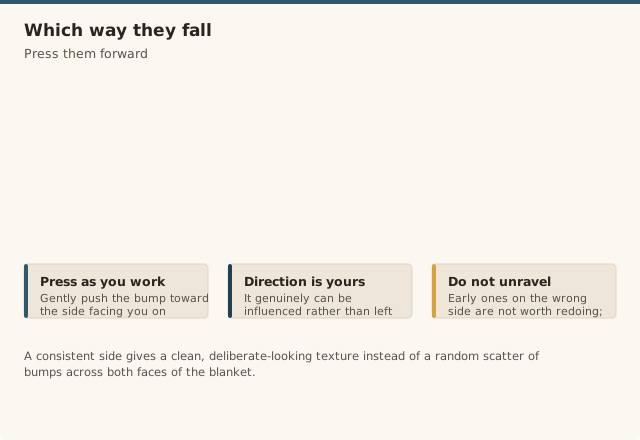
The direction a bobble falls, whether it pops toward you or away from you, is genuinely something you can influence, not just luck. As you work the stitches after a bobble, gently press the bump toward the side of the fabric facing you. Do this consistently on every bobble and they'll all sit on the same side, giving you a clean, deliberate-looking texture instead of a random scatter of bumps on both sides of the blanket. If a few early bobbles do end up on the wrong side before the habit sticks, it's not worth unravelling over; a light block once the piece is finished will help even out any inconsistency without needing to redo the row.
Choosing yarn for texture
A smooth, solid-colour worsted-weight yarn shows off a bobble's rounded shape far better than a fuzzy or heavily variegated one, since the bobble depends on visible shadow and a clean silhouette to read clearly against the background. Dusty, muted shades like the blue shown here are especially good at this, since a soft colour lets the texture itself be the visual interest rather than competing with a bold or busy dye pattern. Our yarn weight guide covers how different weights affect stitch definition if you're substituting yarn, and it's worth swatching a few bobbles in your chosen yarn before committing to the full blanket, since some fibers show the raised texture far more clearly than others.
Sizing up or down
This pattern's stitch count is built on a multiple of 4 plus 3, which keeps the bobble spacing even across the row. To resize the width, add or subtract in multiples of 4 (adjusting the plus-3 remainder stays the same), and to change the length, simply work more or fewer paired plain-and-bobble rows. At this gauge, roughly 12 stitches equal 4 inches, so each group of 4 added stitches adds a little over an inch of width. If you'd rather space the bobbles further apart for a subtler texture, work 2 or 3 plain rows between each bobble row instead of just 1 — the blanket will simply take a little longer to reach the same finished length.
Care & washing
Check your yarn's ball band before washing, and use a gentle or delicate cycle in a mesh laundry bag if it's machine-washable. Always dry a bobble stitch piece flat rather than hanging it: the raised bobbles add extra weight per square inch compared to a plain stitch, and a hanging wet blanket will stretch under that weight, pulling the bobbles out of their neat rows over time. Our guide to washing crochet items covers fiber-specific care if you're not sure what your yarn needs.
Common mistakes & fixes
Mistake: bobbles popping to the wrong side of the fabric inconsistently.
Fix: after closing each bobble, gently push it toward the side facing you before working the next stitch. Doing this every time keeps all your bobbles on the same, intentional side.
Mistake: treating a bobble as an extra stitch added to the row, throwing off the stitch count.
Fix: a bobble replaces the plain stitch that would otherwise sit in that spot; it doesn't add to the total. Count bobbles the same as any other single stitch when checking your row.
Mistake: working the bobble so tightly that the final pull-through is a struggle.
Fix: keep your tension slightly looser specifically on the incomplete stitches that build the bobble, or go up half a hook size if closing the cluster consistently feels like a fight.
Mistake: spacing bobbles unevenly because the starting chain wasn't a multiple of 4 plus 3.
Fix: always check your foundation chain against the pattern's stitch count requirement before starting; an off-count foundation is the most common reason a bobble row doesn't line up as expected.
Mistake: choosing a fuzzy or highly variegated yarn that blurs the bobble's rounded shape.
Fix: use a smooth, solid or near-solid worsted-weight yarn. Texture stitches like this rely on visible shadow and a clean silhouette that a busy or fuzzy yarn tends to hide.
Our pick
Yarn
Caron Simply Soft Yarn
A smooth, affordable worsted-weight yarn with clean stitch definition, ideal for showing off a raised bobble texture.
A bobble stitch is a cluster of several incomplete double crochet stitches worked into the same stitch and drawn together with one final pull, creating a raised, rounded bump on the fabric. It's closely related to the popcorn stitch, which uses a slightly different closing technique.
What's the difference between a bobble stitch and a popcorn stitch?
A bobble is closed by pulling the working yarn through all the loops on the hook at once. A popcorn is closed by removing the hook, inserting it into the first stitch of the group, and pulling that first stitch's loop through to close the cluster from outside. Popcorn tends to sit slightly more forward and defined; bobble is softer and rounder.
Why are my bobbles popping through to the wrong side of the blanket?
This usually means the bobble was pushed backward instead of forward when you closed it. After completing each bobble, gently push it toward the side of the fabric facing you as you work the next stitch, so it consistently pops to the right side rather than falling randomly to either side.
How much yarn does a bobble stitch blanket use compared to a plain blanket?
More. Each bobble uses several stitches' worth of yarn clustered into one spot, so a bobble stitch blanket typically uses 20 to 30 percent more yarn than a plain double crochet blanket of the same finished size.
What size hook should I use for bobble stitch?
A 5mm to 5.5mm hook works well with worsted-weight yarn for a clearly defined bobble that isn't too tight to close. If your bobbles feel difficult to finish, size up half a hook size rather than forcing the final pull-through.
Does a bobble stitch blanket take longer to make than a plain one?
Yes, noticeably. Each bobble takes several times longer than a single plain stitch, so a bobble stitch blanket is a slower project than the same size worked in plain double crochet, though far faster than something like crocodile or Tunisian lace stitches.
Nora has been teaching crochet for 12 years, from absolute beginners to people coming back to the craft after decades away. She started CrochetGuides to write the clear, honest instructions she wishes she'd had when she was learning — the ones that actually work the first time.
CrochetGuides is a participant in the Amazon Services LLC Associates Program. As an Amazon Associate we earn from qualifying purchases, at no extra cost to you.