One row, one colour, one day — a full year of weather turned into a rainbow gradient you can wrap yourself in.
Updated 2026 · US terms · 365 rows, about 40 x 60in / 102 x 152cm finished
A temperature blanket is one of the few crochet projects I recommend as much for what it teaches you about patience and record-keeping as for the finished object. The idea is simple: every day for a year, you work one row in a colour that represents that day's temperature. There's no clever stitch trick to it and no shortcuts, just a small, consistent daily habit that quietly builds into something genuinely stunning, a literal, wearable record of an entire year's weather, stripe by stripe.
What surprises most people who start one isn't the crochet itself, which is deliberately simple, but how attached they get to the ritual of checking the day's temperature and picking up the hook for just a few minutes. I've had students tell me it became the thing that made them notice the weather at all, in a year that otherwise blurred together. The finished blanket ends up telling a story a plain photo album never could: the exact week of an unexpected cold snap, a stretch of unusually warm October days, all preserved in yarn.
This guide covers how to actually set one of these up, from choosing your colour scale to picking which daily temperature to track, plus a simple, fast, lightly textured stitch pattern that won't wear out your patience over 365 repetitions. If you'd rather use a different base stitch entirely, the colour and planning advice here applies just as well to a plain single or half double crochet row.
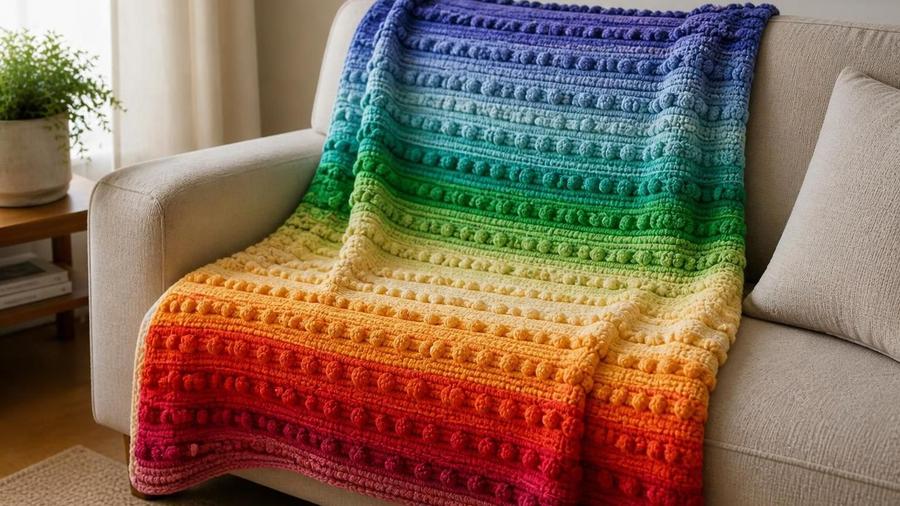
At its core, a temperature blanket is a data visualization you make by hand. Each row corresponds to one day, and the colour of that row is determined by a temperature reading for that day, following a colour scale you decide on before you start. Worked consistently across a full year, the rows build into broad bands that trace the shape of the seasons: cool colours clustered at the start and end of the blanket for winter, gradually shifting through warmer shades toward the middle for summer, and back again.
The appeal is equal parts craft and record-keeping. Some people track their local weather; others use a location that matters to them for a different reason, a childhood hometown, or a year spent somewhere specific. The mechanics stay the same regardless of what you're actually tracking. It's also a genuinely forgiving project for a beginner to commit to long-term, since every row uses the same simple stitch pattern; the only thing that changes from day to day is which colour you pick up, so there's no new technique to learn partway through the year.
Choosing your color scale
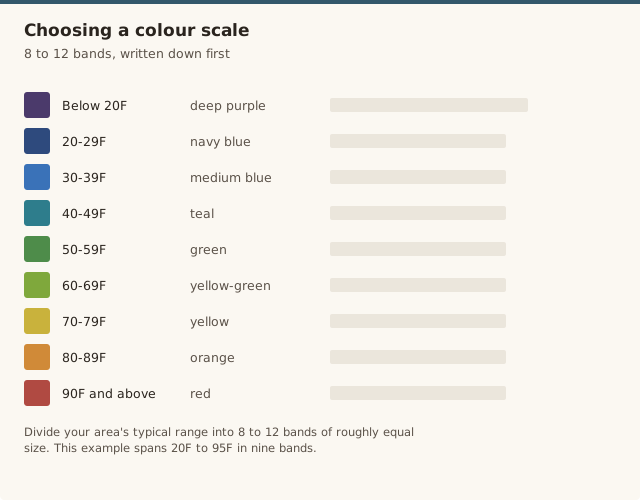
Start by finding your area's typical yearly temperature range, easy to pull from any weather site's historical data. Divide that range into 8 to 12 bands of roughly equal size; for a climate spanning 20°F to 95°F, for example, that might mean bands roughly 8 to 9 degrees wide. Assign one yarn colour to each band, moving in a logical order from cool to warm.
Temperature range (example)
Suggested colour
Below 20°F
Deep purple
20–29°F
Navy blue
30–39°F
Medium blue
40–49°F
Teal
50–59°F
Green
60–69°F
Yellow-green
70–79°F
Yellow
80–89°F
Orange
90°F and above
Red
Write your finalized scale down somewhere permanent before you start, a note on your phone or a card kept with your yarn, since you'll be referring back to it daily for a year and any ambiguity in the bands will show up as inconsistency in the finished blanket.
High, low, or average temperature?
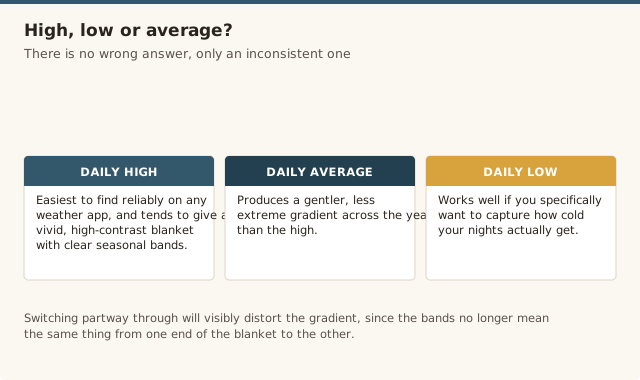
Any of the three works as a tracking method, but pick one and stay consistent for the entire project, since switching partway through will visibly distort your gradient. The daily high is the most common choice, since it's easy to find on any weather app and tends to produce a vivid, high-contrast blanket with clear seasonal bands. The daily average produces a gentler, less extreme gradient, and the daily low works well if you specifically want to capture how cold your nights get. There's no wrong choice; it's purely a matter of which story you want the finished blanket to tell.
Materials
About 100–150 yards of worsted-weight yarn per colour band (roughly 1,000–1,300 yards total across all colours for a typical temperate climate)
5mm (US H-8) crochet hook
A written copy of your colour scale, kept with your project
Yarn needle and scissors
The stitch pattern
Because you're committing to 365 individual sessions, the stitch itself should be quick enough that a single row never feels like a chore. This pattern uses single crochet with a light bobble worked every 5th stitch, giving the finished blanket the subtle raised texture you can see in the photo without the time cost of a full bobble row on every single day.
Foundation
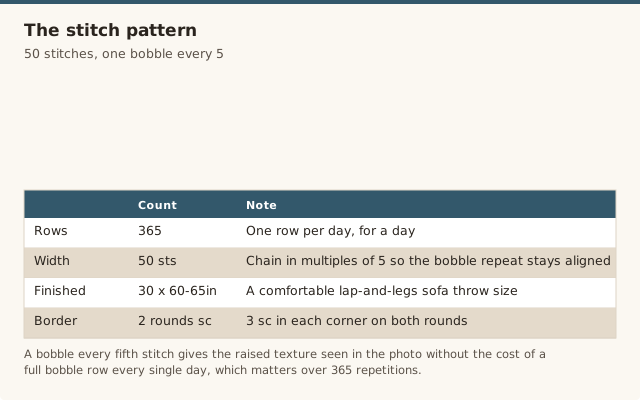
Chain 51. Single crochet in the 2nd chain from the hook, and in each chain across. Turn. (50 sts)
Daily row
Chain 1. Single crochet in the first 2 stitches. *Work a bobble in the next stitch (yarn over, insert hook, pull up a loop, yarn over and pull through 2 loops, 4 times into the same stitch, then pull through all 5 loops to close), single crochet in the next 4 stitches; repeat from * across, ending with single crochet in the last 2 stitches. Turn.
Work this row once per day, changing to that day's temperature colour, for 365 days.
Border
Once all 365 rows are complete, work 2 rounds of single crochet evenly around all four edges, placing 3 single crochet in each corner on both rounds. Join with a slip stitch, fasten off, and weave in the ends.
Staying consistent for a year
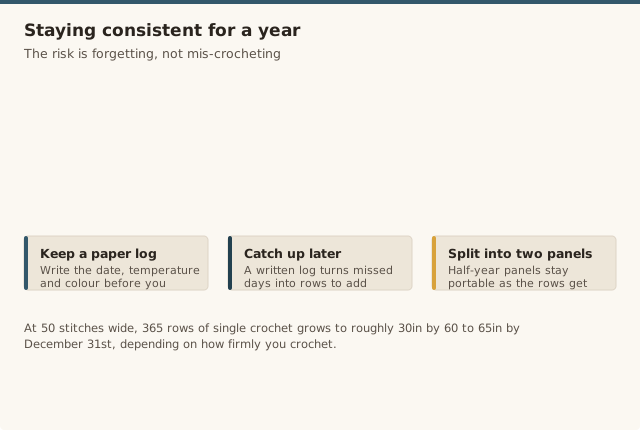
The biggest risk to a temperature blanket isn't a crochet mistake, it's simply forgetting a day. I recommend keeping a small paper log or a note on your phone where you record each day's temperature and colour before you sit down to crochet, separately from the act of crocheting itself. That way, if you miss a day or fall behind by a week, you can catch up the rows later using your log rather than trying to remember or guess retroactively. Our guide to estimating yarn is worth reading early on too, since buying all your colour bands in one purchase avoids a dye-lot mismatch showing up in a blanket you'll be working on for months.
At 50 stitches wide, 365 rows of single crochet grows into a throw roughly 30 inches wide by around 60–65 inches long by the time you reach December 31st, depending on how firmly you crochet, which is a comfortable lap-and-legs size for a sofa throw. If that feels too narrow for the finished blanket you have in mind, chain a wider foundation in multiples of 5 stitches so the bobble repeat still lines up cleanly, and expect the finished width to scale roughly in proportion. Some crocheters also split a single year into two narrower half-year panels crocheted side by side and seamed down the middle at the end, which keeps each half more portable to carry around during the colder months when the rows get bulkier.
Common mistakes & fixes
Mistake: starting without a written, finalized colour scale, then second-guessing which band a borderline temperature belongs to months later.
Fix: write your exact temperature bands and their colours down before day one, and keep that reference with your project for the entire year.
Mistake: switching between tracking the daily high, low, and average partway through the project.
Fix: pick one metric before you start and stay consistent. If you're not sure which to choose, the daily high is the easiest to find reliably every day.
Mistake: falling behind by several days or weeks and losing track of which colour belongs to which missed day.
Fix: keep a separate written log of the date, temperature, and assigned colour for every day, even before you crochet that row. This makes catching up on missed days simple rather than a guessing game.
Mistake: buying each colour band's yarn in small batches throughout the year, risking a dye lot mismatch mid-blanket.
Fix: estimate your likely total yardage per colour upfront and buy each colour's full amount in one purchase at the start, even though you won't use all of it for months.
Mistake: choosing too few colour bands, so most of the year's temperatures fall into just 2 or 3 shades and the gradient looks flat.
Fix: aim for 8 to 12 distinct bands rather than 4 or 5. More bands produce a smoother, more visually interesting gradient across the seasons.
Our pick
Yarn
Red Heart Super Saver Yarn (multi-color packs)
An affordable, widely available worsted-weight yarn sold in a huge range of individual colours, making it easy to build a full 8-to-12-shade temperature scale without hunting across different yarn lines.
A temperature blanket is a crochet or knit blanket where one row (or a small group of rows) represents one day, worked in a colour assigned to that day's temperature. Over a full year, the finished blanket becomes a visual record of the local climate, usually showing a gradient from cool winter shades to warm summer ones and back.
How do I choose colors for a temperature blanket?
Look up your area's typical yearly temperature range, then divide it into 8 to 12 bands of roughly equal size, assigning one yarn colour to each band in a logical order, usually cool colours like blues and purples for cold temperatures through to warm reds and oranges for hot ones.
What temperature should I record for a temperature blanket: high, low, or average?
Any of the three works, as long as you're consistent for the whole year. The daily high is the most common choice since it's easy to find and gives a vivid, high-contrast result, but some crocheters prefer the daily average for a gentler gradient.
How many skeins of yarn does a temperature blanket need?
This depends on your climate and colour count, but budget for roughly 100 to 150 yards per colour band for a year of single rows at this pattern's gauge, and expect warmer or colder climate colours to be used more heavily than the mid-range shades in a typical temperate climate.
Can I start a temperature blanket partway through the year?
Yes. Many people start on January 1st for a clean calendar-year record, but starting on any date and working 365 consecutive days from there works just as well, and some crocheters prefer starting on a birthday or another personal date instead.
What stitch is best for a temperature blanket?
A quick, simple stitch is best, since you're working it daily for a year. This pattern uses single crochet with a light bobble accent every few stitches for texture, but any consistent single-row stitch, including plain single or half double crochet, works equally well.
Nora has been teaching crochet for 12 years, from absolute beginners to people coming back to the craft after decades away. She started CrochetGuides to write the clear, honest instructions she wishes she'd had when she was learning — the ones that actually work the first time.
CrochetGuides is a participant in the Amazon Services LLC Associates Program. As an Amazon Associate we earn from qualifying purchases, at no extra cost to you.